

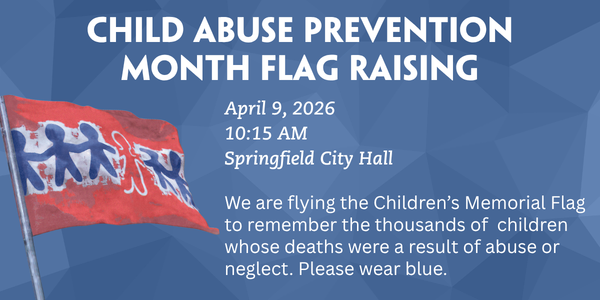
Each April, we recognize National Child Abuse Prevention Month and the importance of increasing awareness about child and family well-being. We will be sharing resources all month long, as well as hosting a Flag Raising Ceremony: Child Abuse Prevention Month at Springfield City Hall on April 9.
Statistics of Child Abuse and Neglect
- 7.4 in 1,000 children are victims of maltreatment nationwide
- 14.9 in 1,000 children are victims of maltreatment in the state of Massachusetts
- 21 in 1,000 children under the age of 1 are victims of abuse
- Children under 1 represent 44% of child fatalities from maltreatment
- The majority (76.0%) of perpetrators are parent(s) to their victim
Identifying Signs of Child Abuse and Neglect
Signs of Physical Abuse
- Bruising, welts or burns that cannot be sufficiently explained
- Unusual bruising patterns that reflect the shape of the instrument used to cause injury (e.g., belt, wire hanger, hairbrush, hand, human bite marks)
- Clusters of bruises, welts or burns, indicating repeated contact with a hand or instrument
- Injuries on the body where children usually do not get hurt (e.g., the torso, back, buttocks, thighs, neck)
- Burns that are insufficiently explained, e.g., cigarette burns
- Rope or restraint burns on the arms, hands, neck or legs
- Lacerations and abrasions of the lip, eye, or to any part of a child’s face
- Tears in the tissue of the gums, possibly as a result of force-feeding
- Laceration or abrasion to external genitalia
- Absence of hair or hemorrhaging beneath the scalp due to vigorous hair pulling
- Withdrawn, fearful or extreme behavior
Signs of Neglect
- Shows sudden changes in behavior or school performance
- Is frequently absent from school or child care
- Has not received help for physical or medical problems brought to parent or caregiver’s attention
- Has learning problems (or difficulty concentrating) that cannot be attributed to specific physical or psychological causes
- Is always watchful, as though preparing for something bad to happen
- Begs or steals food or money
- Lacks adult supervision
- Is consistently dirty and has severe body odor
- Lacks sufficient clothing for the weather
Signs of Sexual Abuse
- Difficulty walking or sitting
- Pain or itching in the genital area
- Torn, stained or bloody underclothing
- Bruises or bleeding in external genitalia
- Frequent complaints of stomachaches or headaches
- Venereal disease
- Frequent urinary or yeast infections
- Pregnancy
- Withdrawal or chronic depression
- Inappropriate sex play or premature understanding of sex
- Feeling threatened by physical contact, closeness
- Promiscuity
- Running away from home
- Child is “parentified” or overly concerned for siblings
- Poor self-esteem, lack of confidence
- Peer problems, lack of involvement with friends
- Extreme weight change
- Suicide attempts or threats; especially with adolescents
- Hysteria, lack of emotional control
Signs of Sexual Exploitation or Trafficking
- Instability in life functioning: Youth lacks access to basic needs, including stable shelter, and is unable to engage in activities expected of her/his age
- Relationships: Youth’s relationships are concerning, placing him/her at risk or in danger
- Finances and belongings: Youth has money or material goods that are incongruent with her/his life circumstances
- Use of technology: Youth’s use of internet, cell phone or social media involves social or sexual behavior that is atypical for his/her age
- Physical health: Youth has significant health problems related to sexual activity and lack of access to basic needs
- Risky behaviors: Youth engages in dangerous or risky behaviors, e.g., spending time with abusive partners or in locations where exploitation is known to occur, running away or staying away overnight, using substances)
- Trauma exposure/signs: Youth has been exposed to traumatic circumstances and/or exhibits signs and emotional symptoms of trauma exposure
- Coercion and grooming: Youth exhibits behaviors or otherwise indicates he/she is being controlled or coerced by another person
Reporting Suspected Abuse or Neglect
Who typically reports child maltreatment?
In 2023, mandated reporters filed 70.9% of reports alleging child abuse and neglect. Neighbors, friends, and relatives submitted 14.8%.
Who is a mandated reporter?
Massachusetts state law requires professionals whose work brings them in contact with children to notify DCF if they suspect that a child is being abused and/or neglected. This includes:
- Physicians, medical interns, hospital personnel engaged in the examination, care or treatment of persons, medical examiners
- Emergency medical technicians, dentists, nurses, chiropractors, podiatrists, optometrists, osteopaths
- Public or private school teachers, educational administrators, guidance or family counselors
- Early education, preschool, child care or after school program staff, including any person paid to care for, or work with, a child in any public or private facility, home or program funded or licensed by the Commonwealth, which provides child care or residential services. This includes child care resource and referral agencies, as well as voucher management agencies, family child care providers and child care food programs
- Child care licensors, such as staff from the Department of Early Education and Care
- Social workers, foster parents, probation officers, clerks magistrate of the district courts parole officers
- Firefighters and police officers
- School attendance officers, allied mental health and licensed human services professionals
- Psychiatrists, psychologists, clinical social workers, drug and alcoholism counselors
- Persons in charge of a medical or other public or private institution, school or facility or their agents
- Clergy members, including ordained or licensed leaders of any church or religious body, persons performing official duties on behalf of a church or religious body, or persons employed by a religious body to supervise, educate, coach, train or counsel a child on a regular basis
- The Child Advocate
How to Report Child Abuse or Neglect
During regular business hours (8:45am-5pm M-F), call the DCF area office that serves where the child lives. On nights, weekends, and holidays, call the Child-at-Risk Hotline (800) 792-5200.
Read More / Sources
https://cwoutcomes.acf.hhs.gov/cwodatasite/byState/massachusetts/#fn9